
 866-589-5339



I’m Moving: Will My Car Insurance Go Up?
How your new ZIP code will affect your car insurance premiums
Get quotes from providers in your area

Discover rates as low as $24 /month


Last updated: August 13, 2026
Will your car insurance rates decrease or increase if you move to a new state, or even a new ZIP code within your state — or even a new country? In short, it depends.
One of the key characteristics of the U.S. is that every state has its own laws, in addition to being subject to federal regulations. As a result of this state power, car insurance looks pretty different depending on what state you’re in. And that means there’s no one-size-fits-all answer to this question.
To find out how your insurance rates will be affected, call one of our Perfect Policy Connectors to learn more about your new location and get an estimate (see below).
Will My Car Insurance Rates Increase If I Move?
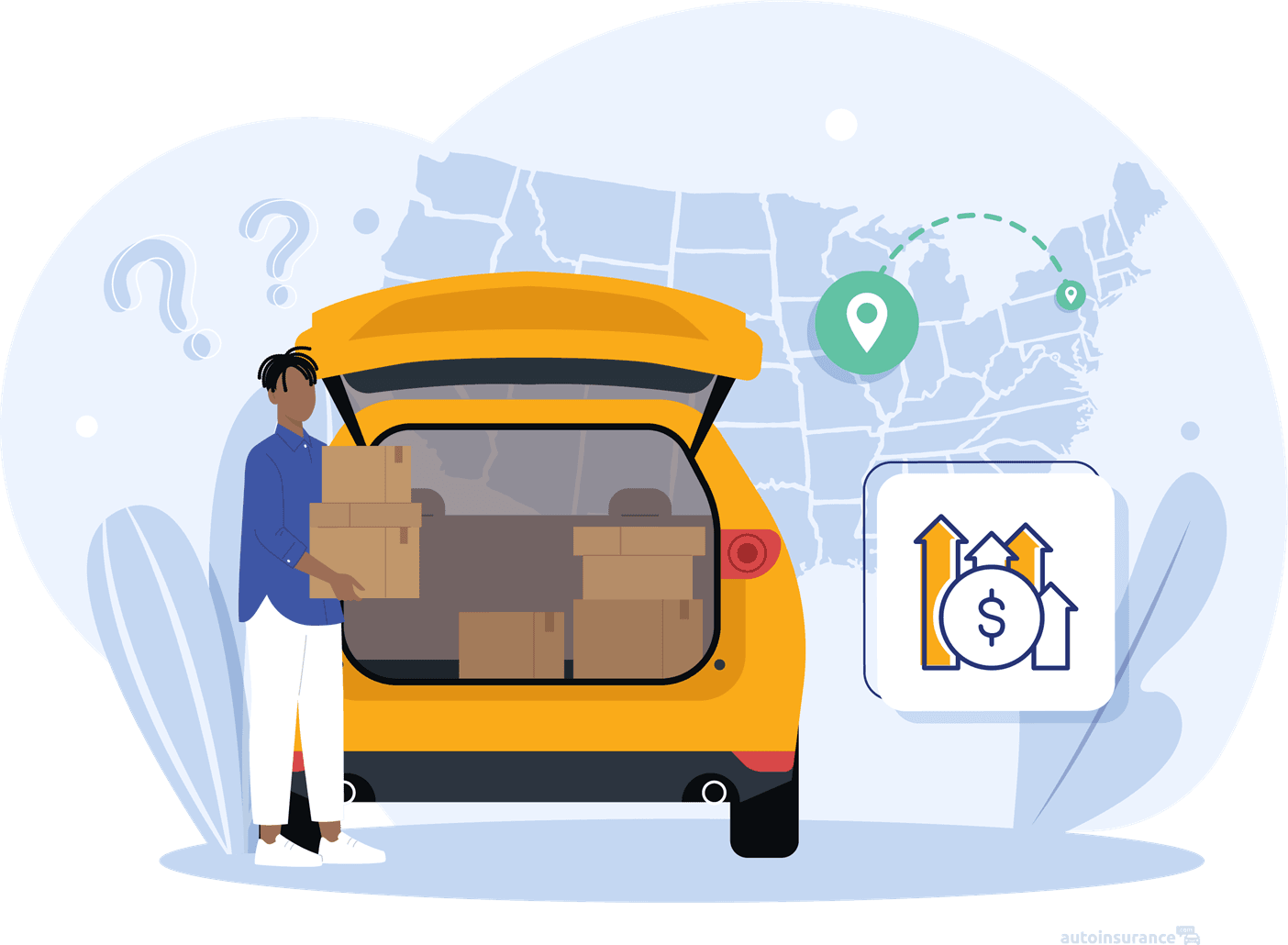
The average cost of car insurance varies by state, so if you move to a state with higher average costs, your rates could increase, and vice versa. For example, Louisiana has the highest rates in the U.S., while Maine has the lowest rates, so moving to either of those locations could have a significant impact on your premiums. Check out the average rates in your current state and your new state to estimate if your car insurance will likely increase or decrease.
| State | Average annual cost of car insurance in 2019 (low to high) |
|---|---|
| Maine | $696.37 |
| North Dakota | $703.73 |
| Iowa | $714.86 |
| Idaho | $738.10 |
| North Carolina | $741.70 |
| South Dakota | $745.33 |
| Wisconsin | $767.42 |
| Wyoming | $776.22 |
| Indiana | $777.05 |
| Vermont | $785.37 |
| Ohio | $802.72 |
| Nebraska | $807.30 |
| Kansas | $818.99 |
| Montana | $834.86 |
| Hawaii | $839.87 |
| Virginia | $861.18 |
| Tennessee | $863.39 |
| New Hampshire | $864.35 |
| Minnesota | $892.17 |
| Arkansas | $897.92 |
| Oklahoma | $908.95 |
| Missouri | $929.91 |
| Alabama | $932.14 |
| New Mexico | $932.67 |
| Kentucky | $935.61 |
| Illinois | $939.64 |
| West Virginia | $946.03 |
| Utah | $954.14 |
| Mississippi | $975.58 |
| Oregon | $990.00 |
| Alaska | $991.09 |
| Pennsylvania | $992.33 |
| California | $1,051.79 |
| Arizona | $1,063.93 |
| Washington | $1,066.84 |
| South Carolina | $1,114.90 |
| Texas | $1,143.85 |
| Colorado | $1,174.87 |
| Massachusetts | $1,182.69 |
| Maryland | $1,236.61 |
| Connecticut | $1,237.55 |
| Georgia | $1,259.49 |
| District of Columbia | $1,289.93 |
| Nevada | $1,292.52 |
| Rhode Island | $1,382.64 |
| New Jersey | $1,395.53 |
| Florida | $1,414.17 |
| Delaware | $1,440.58 |
| New York | $1,445.30 |
| Michigan | $1,495.94 |
| Louisiana | $1,557.221 |
How Your Address Impacts Car Insurance Rates
Where you live affects car insurance rates because of the different state laws governing various aspects of auto coverage.
- Minimum insurance requirements: Each state has different requirements for what car insurance coverages you need and the minimum limits for each coverage type. For example, New Jersey is one of the few states that doesn’t require bodily injury liability coverage. However, Michigan has the strictest requirements of all — policies must cover up to $1 million worth of property damage for accidents that occur in the state. The more coverage and the higher limits required, the more expensive car insurance will be.
- Fault laws: In an at-fault state, the at-fault driver is responsible for the other party’s injuries, whereas in a no-fault state, each party pays for their own injuries under personal injury protection (PIP) regardless of fault. Insurance tends to cost more in no-fault states due to increased amounts of insurance fraud and lawsuits.
| State | Fault system |
|---|---|
| Alabama | At fault |
| Alaska | At fault |
| Arizona | At fault |
| Arkansas | No fault |
| California | At fault |
| Colorado | At fault |
| Connecticut | At fault |
| Delaware | No fault |
| District of Columbia | At fault |
| Florida | No fault |
| Georgia | At fault |
| Hawaii | No fault |
| Idaho | At fault |
| Illinois | At fault |
| Indiana | At fault |
| Iowa | At fault |
| Kansas | No fault |
| Kentucky | Optional |
| Louisiana | At fault |
| Maine | At fault |
| Maryland | At fault |
| Massachusetts | No fault |
| Michigan | At fault |
| Minnesota | No fault |
| Mississippi | At fault |
| Missouri | At fault |
| Montana | At fault |
| Nebraska | At fault |
| Nevada | At fault |
| New Hampshire | At fault |
| New Jersey | Optional |
| New Mexico | At fault |
| New York | No fault |
| North Carolina | At fault |
| North Dakota | No fault |
| Ohio | At fault |
| Oklahoma | At fault |
| Oregon | At fault (but requires PIP) |
| Pennsylvania | Optional |
| Rhode Island | At fault |
| South Carolina | At fault |
| South Dakota | At fault |
| Tennessee | At fault |
| Texas | No fault |
| Utah | No fault |
| Vermont | At fault |
| Virginia | At fault |
| Washington | At fault |
| West Virginia | At fault |
| Wisconsin | At fault |
| Wyoming | At fault |
- Population density: More people in a given place means higher accident rates and thus, more claims for auto insurance companies to pay.
| State | Number of people per square mile in 2021 (high to low) |
|---|---|
| District of Columbia | 10,984 |
| New Jersey | 1,260 |
| Rhode Island | 1,060 |
| Massachusetts | 895 |
| Connecticut | 745 |
| Maryland | 635 |
| Delaware | 515 |
| New York | 421 |
| Florida | 406 |
| Pennsylvania | 290 |
| Ohio | 288 |
| California | 252 |
| Illinois | 228 |
| Hawaii | 224 |
| Virginia | 219 |
| North Carolina | 217 |
| Indiana | 190 |
| Georgia | 188 |
| Michigan | 178 |
| South Carolina | 173 |
| Tennessee | 169 |
| New Hampshire | 155 |
| Washington | 116 |
| Kentucky | 114 |
| Texas | 113 |
| Wisconsin | 109 |
| Louisiana | 107 |
| Alabama | 100 |
| Missouri | 90 |
| West Virginia | 74 |
| Minnesota | 72 |
| Vermont | 70 |
| Arizona | 64 |
| Mississippi | 63 |
| Arkansas | 58 |
| Oklahoma | 58 |
| Iowa | 57 |
| Colorado | 56 |
| Maine | 44 |
| Oregon | 44 |
| Utah | 41 |
| Kansas | 36 |
| Nevada | 29 |
| Nebraska | 26 |
| Idaho | 23 |
| New Mexico | 17 |
| South Dakota | 12 |
| North Dakota | 11 |
| Montana | 8 |
| Wyoming | 6 |
| Alaska2 | 1 |
- Commute: If your move means a longer commute, you could pay more for car insurance. On the other hand, if you have a shorter or no commute at all, you could see decreased rates.
TIP
If your move means you’re driving less in general, consider usage-based or pay-per-mile insurance. Rather than a flat rate, you’ll pay based on how much you drive.
- Crime rates: Crimes like auto theft and vandalism impact car insurance costs as well. The higher the rates for these sorts of crimes, the more comprehensive claims an area sees. Colorado has the highest car theft rates in the U.S., while Vermont has the lowest.
| State | Auto theft rate per 100,000 inhabitants in 2019 (high to low) |
|---|---|
| Colorado | 524 |
| Washington D.C. | 477 |
| California | 428 |
| New Mexico | 428 |
| Missouri | 393 |
| Oregon | 391 |
| Hawaii | 380 |
| Oklahoma | 378 |
| Washington | 356 |
| Nevada | 336 |
| Utah | 317 |
| Tennessee | 306 |
| Texas | 287 |
| South Carolina | 282 |
| North Dakota | 271 |
| Alaska | 269 |
| Louisiana | 267 |
| Arkansas | 262 |
| Nebraska | 261 |
| South Dakota | 259 |
| Kentucky | 257 |
| Minnesota | 250 |
| Kansas | 248 |
| Montana | 248 |
| Arizona | 242 |
| Georgia | 238 |
| Connecticut | 237 |
| Indiana | 229 |
| Alabama | 222 |
| Mississippi | 205 |
| Iowa | 197 |
| North Carolina | 194 |
| Michigan | 185 |
| Florida | 176 |
| Maryland | 173 |
| Ohio | 172 |
| Illinois | 170 |
| Delaware | 169 |
| Wyoming | 166 |
| Wisconsin | 161 |
| Rhode Island | 143 |
| West Virginia | 127 |
| Virginia | 126 |
| Pennsylvania | 121 |
| New Jersey | 116 |
| New York | 102 |
| Massachusetts | 99 |
| Idaho | 97 |
| New Hampshire | 76 |
| Maine | 64 |
| Vermont | 423 |
The FBI doesn’t track car vandalism specifically, but it’s safe to say that if you move to a more crime-ridden area within a state, your insurance rates might increase. That’s why car insurance tends to cost more in urban areas, followed by suburban and rural areas.
- Weather: Aside from auto theft and vandalism, comprehensive coverage also covers weather events like natural disasters and hail. States more prone to hurricanes, like Louisiana and Florida, have higher average rates as a result. Similarly, states with more hail damage see higher premiums too. Here are the top 10 states for hail loss claims.
| State | Number of hail loss claims in 2019 (high to low) |
|---|---|
| Texas | 192,988 |
| Colorado | 69,742 |
| Nebraska | 56,897 |
| Kansas | 50,737 |
| Minnesota | 49,973 |
| Illinois | 47,798 |
| Missouri | 33,976 |
| North Carolina | 25,056 |
| Iowa | 19,744 |
| Indiana | 18,4044 |
Other Factors That Affect Your Rates

In addition to the city and state you live in, there are other criteria insurers take into account when developing your car insurance rate.
- Marriage: If you get married, your rate could decrease, as married people are statistically less likely to file claims.
- Credit score: Not every state allows car insurance companies to base rates on credit scores, although the majority does. However, if you live in or move to Michigan, Hawaii, California, or Massachusetts, your credit score won’t be taken into consideration, which could be a good or bad thing for you, depending on your score.
- Age: Young drivers under the age of 25 have the highest rates due to their lack of driving experience and greater likelihood of at-fault accidents and claims. Rates typically decrease starting from the age of 25, however.
What to Do If Your Rate Increases
If your insurance rate increases when you move, there are ways to save.
- Drop coverages: The least expensive insurance is minimum coverage. You can drop coverages like comprehensive and collision coverage, which no states require, or add-ons like rental car coverage. However, keep in mind that the fewer coverages you have, the more you may have to pay if you have a claim.
- Increase your deductible: Increasing the size of your deductible will lower your car insurance rates, but make sure you’ll actually be able to pay that larger deductible amount in the event of a covered claim.
- Bundle home and auto: Bundling is another easy way to save money on car insurance. When you’re moving, bundle your homeowners, renters, or condo insurance with your auto insurance to save money.
- Ask for discounts: Every car insurance company has some discount offers available, from signing up for paperless billing to getting early quotes. Ask your insurance agent how you can save.
- Switch companies: If you’ve done all the above and still can’t afford your car insurance, consider switching to a new provider.
Car Insurance Moving Checklist
- Notify your insurer: The easiest way to find out if you need new car insurance for your new place of residence is to contact your agent. Not every insurance company covers every state. Also, your current provider may not be the most affordable option in your new state. And if you’re moving out of the country, you’ll definitely need an entirely new policy. Notify your insurer as soon as you have your moving date and new address.
- Update your address: You’ll need to provide your insurer, be it your old provider or new, with proof of your new address, which could be in the form of a recent pay stub, W-2, utility bill, or driver’s license. This is required so companies can prevent insurance fraud.
- Switch companies: Finally, change your car insurance while moving out of state. Shop around for an affordable quote, and make sure your old and new policies overlap so you’re never driving without insurance.
Do You Need New Car Insurance to Register Your Car?
In order to register your car in your new state, you’ll need in-state car insurance. Two exceptions are New Hampshire and Virginia, the only states that don’t require auto insurance.
That said, in Virginia, you’ll need to pay the state’s $500 Uninsured Motorist Fee to register your vehicle6. New Hampshire, on the other hand, doesn’t require proof of financial responsibility for car registration. Rather, you’ll need only the car title and proof of residency. If the vehicle is leased instead of owned, you’ll need the lease agreement, lienholder name and address, and out-of-state registration7.
DID YOU KNOW?
Even if you don’t need insurance to register your car in New Hampshire, the alternative to insurance is that you need to prove you can meet $25,000 of bodily injury coverage for one person, $50,000 of bodily injury coverage per car accident, and $25,000 of property damage coverage per vehicle.
How States Regulate Car Insurance
Every state except Wyoming regulates the car insurance industry to ensure insurance carriers can pay claims, and that rates are reasonable and not discriminatory. Here are the regulatory systems states use.
- File and use: Also known as competitive ratings, in file-and-use states, car insurance companies must file their rates before they use them. However, prior approval isn’t required. Retroactively, regulators can reject rates they deem inadequate, excessive, or unfairly discriminatory. If a regulator rejects a rate, the company may have to refund amounts to policyholders or even pay fines.
- Prior approval: In contrast, in prior approval states, companies must get regulator approval before their policies and rates can go into effect.8
- Use and file: The opposite of file and use, in use-and-file states, insurers file the rates after they use them in the market.
- Flex: Flex states allow insurance companies to use rates without notice, as long as they’re within a certain range.
- Limited flex: Limited flex states are flex states with a more narrow range and more constraints.
- Deregulated: In a deregulated state like Wyoming, there is no state review of rates, and insurers aren’t required to file their rates with the state.9
See your state’s regulatory system below.
| State | Insurance regulatory system |
|---|---|
| Alabama | Prior approval |
| Alaska | Flex |
| Arizona | Use and file |
| Arkansas | File and use |
| California | Prior approval |
| Colorado | File and use |
| Connecticut | Prior approval |
| Delaware | File and use |
| District of Columbia | File and use |
| Florida | File and use |
| Georgia | Prior approval |
| Hawaii | Prior approval |
| Idaho | Use and file |
| Illinois | Use and file |
| Indiana | File and use |
| Iowa | Use and file |
| Kansas | Flex |
| Kentucky | Flex |
| Louisiana | Prior approval |
| Maine | File and use |
| Maryland | File and use |
| Massachusetts | File and use |
| Michigan | File and use |
| Minnesota | File and use |
| Mississippi | Prior approval |
| Missouri | Use and file |
| Montana | File and use |
| Nebraska | File and use |
| Nevada | Prior approval |
| New Hampshire | File and use |
| New Jersey | Prior approval |
| New Mexico | File and use |
| New York | Limited flex |
| North Carolina | Prior approval |
| North Dakota | Limited flex |
| Ohio | File and use |
| Oklahoma | Use and file |
| Oregon | File and use |
| Pennsylvania | Prior approval |
| Rhode Island | Use and file |
| South Carolina | Flex |
| South Dakota | File and use |
| Tennessee | Limited flex |
| Texas | File and use |
| Utah | Use and file |
| Vermont | Use and file |
| Virginia | File and use |
| Washington | Prior approval |
| West Virginia | Prior approval |
| Wisconsin | Use and file |
| Wyoming | Degulated |
Hopefully, your move will cause your car insurance rates to decrease instead of increase, which could be a boon to your personal finances. To learn more, keep reading our FAQs below.

Frequently Asked Questions
No, it doesn’t cost money to change the address of your car insurance.
Yes, you can drive a new car home on your old insurance; your old policy will cover it for a grace period, the length of which differs by company. However, it’s best to buy new insurance before you drive your new car.
If you’re moving abroad, cancel your old car insurance and get a driver’s license in your new country. Then, buy new car insurance and register the car in your new country.
Citations
2018/2019 Auto Insurance Database Report. NAIC. (2022).
https://content.naic.org/sites/default/files/publication-aut-pb-auto-insurance-database.pdfCounty Population by Characteristics: 2020-2021. United States Census Bureu. (2022).
https://www.census.gov/data/tables/time-series/demo/popest/2020s-counties-detail.htmlMotor Vehicle Theft. FBI. (2022).
https://ucr.fbi.gov/crime-in-the-u.s/2019/crime-in-the-u.s.-2019/topic-pages/motor-vehicle-theftThe Hail Hazard and Its Impact on Property Insurance. Verisk. (2021).
https://www.verisk.com/siteassets/media/campaigns/gated/underwriting/the-hail-hazard-and-its-impact-on-property-insurance.pdf?__FormGuid=b105adc4-533b-41a0-8bc3-0eaa9c9d1e6d&__FormLanguage=en-US&__FormSubmissionId=8319d1b6-b4f7-499c-8dca-982ba2a8b373Is car insurance impacted when moving? Progressive. (2022).
https://www.progressive.com/answers/how-moving-impacts-car-insurance/Vehicle Registration Is Required by Law. Virginia Department of Motor Vehicles. (2022).
https://www.dmv.virginia.gov/vehicles/#vehiclereg.aspNew Resident to New Hampshire. New Hampshire Division of Motor Vehicles. (2022).
https://www.dmv.nh.gov/vehicles-boats-or-titles/vehicle-registrations/new-resident-new-hampshireInsurance Regulation. Rocky Mountain Insurance Information Association. (2022).
http://www.rmiia.org/industry/Insurance_Regulation.aspAuto Insurance Regulation What Works 2019. Rocky Mountain Insurance Information Association. (2019).
https://consumerfed.org/wp-content/uploads/2019/02/auto-insurance-regulation-what-works-2019.pdf
Related Articles

Dairyland Car Insurance Pricing 2026
August 12, 2026
Protect My Car Warranty Review
October 22, 2025